Date: 2025-12-20
Choosing a hydraulic fitting might seem like a small task, but it is the most critical link in your machinery. A wrong fitting leads to leaks, pressure drops, and dangerous blowouts.
At Amco Hydraulics, we want to make sure you get it right the first time. Here is our expert guide to choosing the correct hydraulic fittings.
Before you buy, you need to know how the fitting connects. There are two main types:
Permanent (Crimped): These are used mostly in hose assemblies and require a crimping machine. They are the most secure.
Reusable (Field Attachable): These can be installed with a wrench and are great for emergency repairs on-site.
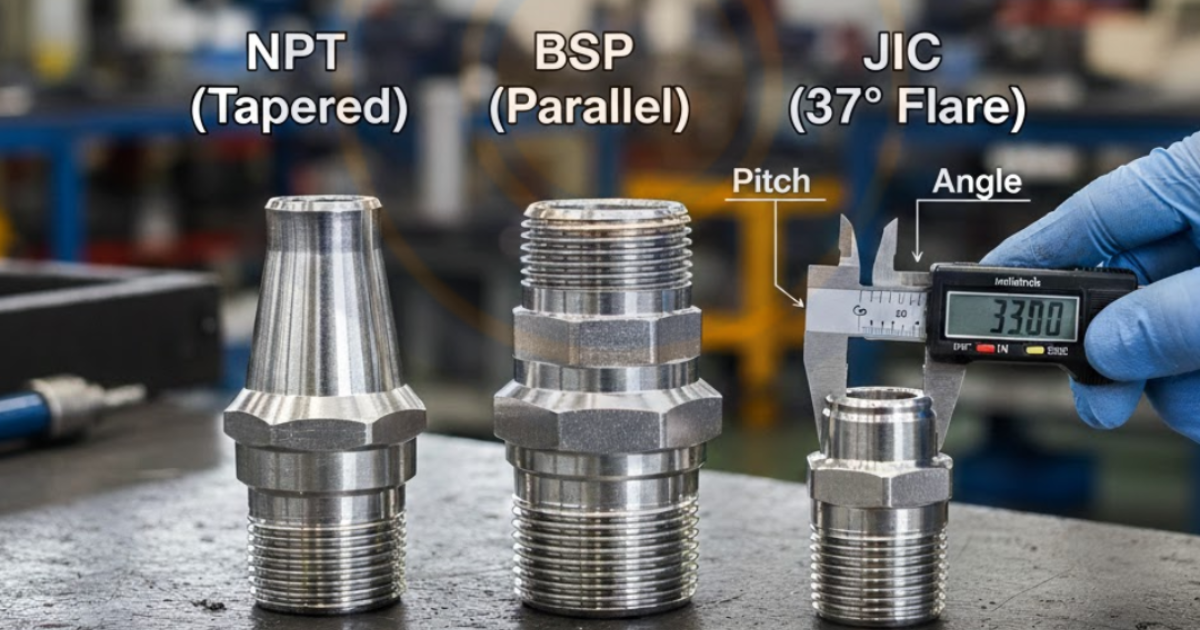
This is where most people make mistakes. You must match the thread of the fitting with the port on your machine.
NPT (American): Tapered threads that seal by metal-to-metal contact.
BSP (British): Very common in India. Can be parallel or tapered.
Metric: Common on European machinery.
JIC (37° Flare): Uses a flared tube to create a seal.
Pro Tip: Use a Thread Gauge or a Caliper to measure the distance between threads. Never "guess" by looking at it!
To ensure total safety, always remember the STAMPED acronym:
S (Size): Match the Inside Diameter (ID) and Outside Diameter (OD).
T (Temperature): Ensure the fitting can handle the heat of your hydraulic oil.
A (Application): Where will it be used? (e.g., Underground, High-Vibration).
M (Material): Steel is standard; Stainless Steel is for corrosive environments; Brass for low pressure.
P (Pressure): The fitting must have a "Working Pressure" equal to or higher than your system’s maximum pressure.
E (Ends): The specific type of connectors (Male vs. Female).
D (Delivery): Is it for a high-volume flow or a small control line?
O-Ring Face Seals (ORFS): These are the best for preventing leaks in high-pressure systems. The rubber O-ring acts as a barrier.
Metal Sealing: Uses the shape of the metal (tapered threads) to stop leaks. These are durable but can leak if over-tightened.
What is the maximum system pressure?
What is the operating temperature?
What is the thread size and pitch?
Is the environment corrosive (do you need Stainless Steel)?
Don't risk a breakdown by using the wrong part. At Amco Hydraulics, we stock a massive range of high-pressure fittings, adapters, and connectors.